 Dotalyn
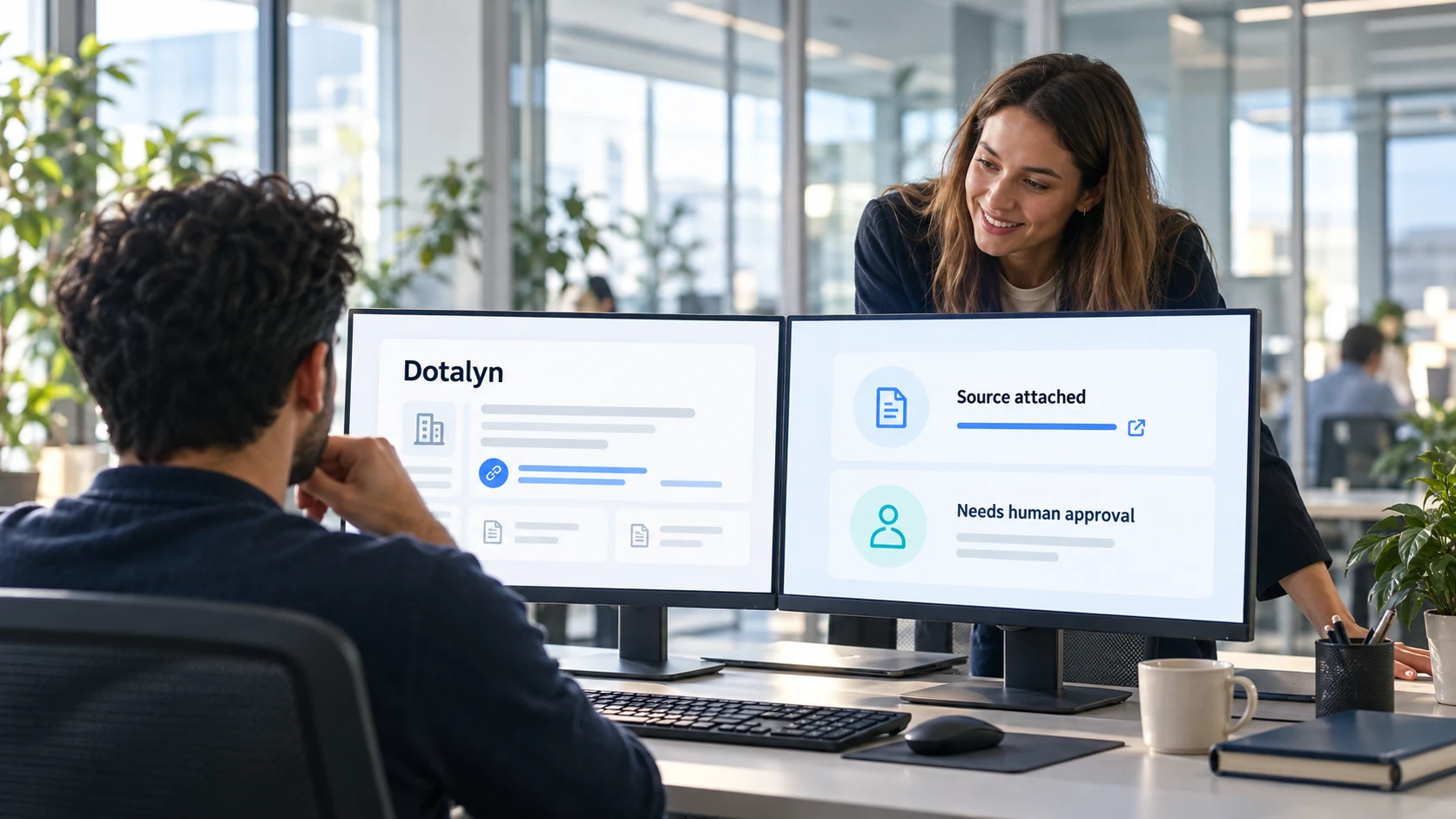
I know what we sell. The work is carrying that understanding into a useful customer conversation, with enough context for someone to make a sound decision.
That is where the idea for Dotalyn began. I wanted the account research to stay connected to the offer, and I wanted the person reviewing a message to see the reasoning behind it. Every handoff should carry the background that makes the next step understandable.
The idea that shaped Dotalyn
The principle in my early drafts was simple: give AI clearly defined operational work, and keep authority over important decisions with people. That principle needed a place in the workflow itself. An agent needs a bounded assignment, and a reviewer needs to know what they are authorizing.
I started thinking about the customer record as a place where work could be prepared and carried forward. Research could arrive with its sources. A proposed message could arrive with the account context beside it. The person responsible for the next decision could review the exact work in front of them.
AI prepares the next step.
A person owns the decision.
The title of this article is a question about that change. An AI agent can take on a defined preparation task inside a commercial workflow. The human still decides which offer to pursue and what deserves to reach a customer.
Start with one sales motion
Dotalyn's clearest starting point is one repeatable B2B sales motion. Begin with an offer you understand and an account profile you can explain. That gives the research a purpose and gives the reviewer a way to judge whether the proposed outreach belongs.
The initial audience hypothesis is technical founders and specialized B2B service teams. They often know their work in detail. The question to test is whether a connected workflow helps them carry that knowledge through account research and a human-reviewed sales handoff.
- 01Offer
context - 02Sourced
research - 03Linked
messaging - 04Human
approval - 05Sales
handoff
This is the motion I want to make reviewable from beginning to end. Each step should carry the context the next owner needs.
The evidence should travel with the message
An account name does not explain why it belongs on a list. A company announcement can supply useful context, but a reviewer still needs to decide what that context supports. An expansion announcement, for example, does not establish that a company wants to buy from us.
That is why the source needs to stay close to the proposed claim. The reviewer should be able to inspect the supporting record and see where an assumption begins. The draft should make that review possible before a consequential action is authorized.
In Dotalyn's workflow language, the AI personal info agent supports contact research. The Info QA agent and submission agent describe responsibilities for checking information and preparing the authorized handoff. Those responsibilities still depend on the saved policy and the required checks.
Building it changed the questions I asked
My early founder notes describe an initial build of about two weeks, with roughly $500 in direct development expense. I also recorded an operating estimate of around $200 per month at our internal scale.
Those are self-reported early observations. They do not establish customer pricing or economics at a larger scale. Review effort and provider costs still need to be measured in a defined customer workflow.
That early experience made me want to keep building. It also made the next questions concrete: who is the first buyer, and which outcome is useful enough for that buyer to care about? A working internal system gives us a starting point for those tests.
Bring one offer. Follow one account.
My starting point for a conversation about Dotalyn is a real offer and a defined buyer. We can walk through the account research, then look at the evidence a person would need to review a proposed message. The handoff should show what the next sales owner needs to know.
That is the shift behind Dotalyn: make the next piece of work inspectable, and keep the person responsible connected to the decision. I am inviting technical founders and B2B service teams to explore that workflow with us.
Founder perspective, adapted from David Khorram's two drafts on the question “What if your next CRM employee wasn't human?” The build and operating figures are self-reported observations from early internal use.
What would this look like for your offer?
Bring a defined buyer and a real sales motion. Walk through the account evidence and the decision your team needs to make next.
Request a workflow walkthrough Try the interactive workflow